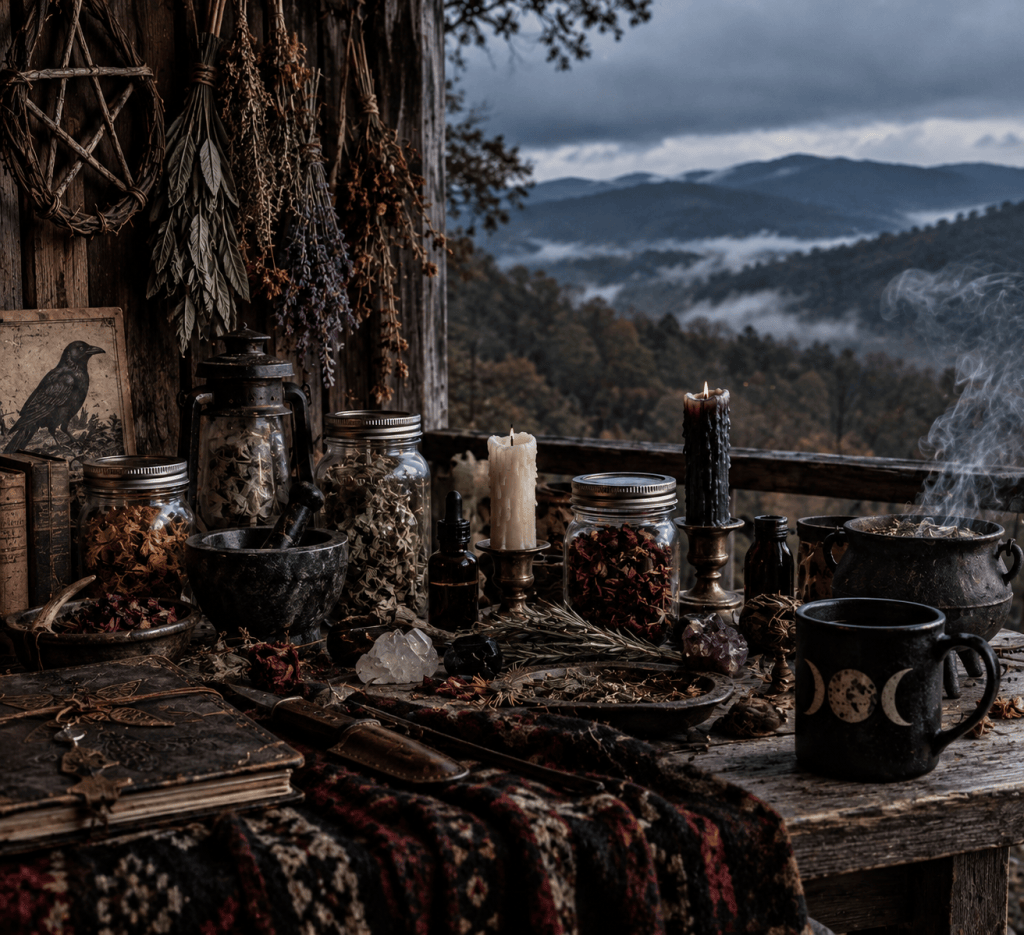
Appalachian folk magic was carried to these mountains by our wise Celtic ancestors.
The Strange, Sacred World of East Tennessee Folk Magic
If you grew up in East Tennessee, there is a decent chance you encountered folk magic long before anybody had the nerve to call it magic.
Maybe your grandmother planted by the signs. Maybe somebody in the family could “talk the fire” out of a burn. Maybe you were told never to rock an empty rocking chair, never to hand somebody a knife without making them give you a penny, or that an itchy palm meant money was coming.Maybe your grandfather could find underground water with a forked stick. Maybe someone put a Bible under a sick child’s pillow, hung a horseshoe over a doorway, swept the porch in a very particular direction, carried a silver dime, or knew exactly which weed growing beside the fence could cure what ailed you.
But if you had asked whether any of this was witchcraft?
Lord have mercy. Absolutely not! It was just something Granny did.
Welcome to Appalachian folk magic, where the line between prayer and spellwork has historically been about as straight as a mountain road. And here in East Tennessee, that story gets particularly interesting.
First Things First: Appalachian Folk Magic Isn’t One Thing
There is no ancient leather-bound Official Appalachian Book of Spells tucked away somewhere in a holler outside Johnson City. Although, frankly, I would like to believe there is.
What we now call Appalachian folk magic developed over generations from a complicated mixture of beliefs, survival strategies, religious traditions, plant knowledge, oral traditions, and cultural exchange.
The Southern Appalachians became home to people carrying traditions from the British Isles and continental Europe, including English, Scottish, Scots-Irish, and German settlers. African and African American traditions also contributed to the broader folk culture of the American South. Indigenous peoples (most importantly the Cherokee here in East Tennessee) possessed sophisticated traditions of medicine, spirituality, and plant knowledge long before European settlers arrived.
Those traditions existed beside one another, interacted, and sometimes influenced one another. But we should be careful with the popular internet version of this history that tosses Cherokee religion, Celtic paganism, hoodoo, German braucherei, and somebody’s Mamaw’s wart cure into one cauldron and announces, Voilà! Appalachian witchcraft!
History is rarely that tidy.
Specific traditions belong to specific peoples, and some Indigenous and African American practices are culturally distinct traditions rather than generic ingredients available for modern “Appalachian witchcraft.”
What is clear is that Appalachia developed an extraordinarily rich body of folk belief.
The Smithsonian describes Appalachian folk magic as a tradition shaped by multiple cultural streams and notes the importance of herbs, household remedies, charms, divination, prayer, and knowledge passed through families. (Smithsonian Folklife)
German influence deserves special mention because it sometimes disappears beneath the enormous Scots-Irish umbrella thrown over Appalachian history. Folklorist Gerald Milnes has documented German Appalachian traditions involving signs, cures, astrology, numerology, healing, and other forms of folk spirituality. (JSTOR)
In other words, Appalachian folk magic wasn’t invented on TikTok in 2021. Shocking, I know.
East Tennessee: Where the Mountains Kept Secrets
East Tennessee was particularly fertile ground for folk traditions because geography mattered.
For generations, many mountain communities were relatively isolated. Doctors could be expensive, distant, or nonexistent. Pharmacies weren’t sitting beside the Food City. People relied on what they had: family knowledge, neighbors, plants, prayer, and experience.
That produced specialists.
There were midwives. Herb doctors—or “yarb doctors.” Blood stoppers. Burn healers. Wart removers. Bonesetters. People reputed to cure thrush. People who could find water. And, of course, the legendary granny woman.
East Tennessee State University research documents the granny woman’s importance in Southern Appalachian childbirth from the late nineteenth into the twentieth century. These women often provided crucial medical and obstetric assistance in communities where professional medical care was difficult to obtain. Their knowledge included herbal treatments that had been passed from mother to daughter from generation to generation. (Digital Commons)
The granny woman has since been romanticized into the Appalachian equivalent of Professor McGonagall with a basket of herbs. However, the reality was less whimsical and far more impressive.
The Granny Witch was often a nurse, midwife, herbalist, counselor, neighbor, spiritual comforter, and emergency medical service rolled into one woman who probably had biscuits in the oven.
Delicious, flaky, buttery biscuits. Mouthwatering biscuits butter baked in an iron skillet. But I digress…
Some healers were believed to possess particular gifts. Appalachian folklore records people known specifically for stopping blood, removing warts, treating burns, or curing thrush. An Appalachian folk-medicine archive identifies titles including “yarb doctor,” “granny woman,” “blood stopper,” “wart remover,” “burn healer,” and bonesetter. (Appalachian Folk Medicine)
And this brings us to the wonderfully complicated elephant in the room.
Wait. Weren’t These People Christian?
Oh, honey. Extremely.
This is perhaps the most fascinating thing about Appalachian folk magic: historically, Christianity and folk magic weren’t on opposite sides of a spiritual war. They co-existed.
And for many practitioners, they were inseparable.
Scholarship on Appalachian religion has argued that Protestant Christianity and folk magic should not always be imagined as two completely separate communities. They frequently existed inside the same worldview. (Esoteric) Realistically, a person might believe wholeheartedly in Jesus Christ, attend church every Sunday, quote Scripture from memory. . . and also believe that certain people had God-given healing abilities, dreams could carry warnings, signs appeared in nature, particular words could stop bleeding, and planting should be done according to celestial signs.
No contradiction required.
From their perspective, the healer wasn’t commanding some supernatural force independent of God. God was the source of the power.
That distinction matters enormously.
Many traditional Appalachian healers would have been horrified to hear themselves called witches. Their gift was understood as something bestowed by God and exercised through faith. Prayer itself could function almost like what a modern practitioner might call an incantation. Scripture could function like a charm. The Psalms could become spiritual technology.
The Smithsonian’s research on Appalachian folk practitioners even records family traditions in which the Psalms were used in ways a modern observer might describe as spell-like, while the practitioners themselves understood their abilities through a Christian framework. (Smithsonian Folklife)
Which creates one of my favorite historical Appalachian contradictions:
“Witchcraft is the Devil’s work. Now hold still while I recite this Bible verse three times and make your wart disappear.”
Makes perfect sense.
The Bible Was Sometimes the Spellbook
To understand Appalachian folk practice, we have to stop applying today’s neat religious categories to people who did not necessarily use them.
Modern culture likes boxes.
Christian.
Pagan.
Witch.
Herbalist.
Healer.
Superstition.
Medicine.
Pick one.
Traditional folk culture often responded with: Why?
A woman might prepare an herbal remedy because she knew the plant worked. She might pray over it because healing ultimately came from God. She might perform the treatment three times because three carried sacred significance. She might recite Scripture while doing it. She might insist the words had to be taught to someone of a particular relationship or at a particular time.
Was that medicine? Religion? Magic? Folklore? The answer is frequently yes. Just yes.
Historical accounts of Southern Appalachian religion show a culture in which formal Protestant theology lived comfortably beside folk beliefs and highly experiential spirituality. (UTK Libraries Databases)
That does not mean Appalachian Christianity was secretly paganism wearing a bonnet. It means lived spiritualityis considerably messier than theology textbooks would have us believe.
Talking Fire, Stopping Blood, and Other Things Mamaw Was Definitely Not Calling Witchcraft
Among the most fascinating Appalachian healing traditions is talking fire out of a burn.
The basic concept appears in several regional traditions: a person believed to possess a healing gift recites particular words or prayers over a burn. The ritual may involve breath, touch, scripture, or a formula that is traditionally passed from one person to another. Similar traditions existed around stopping bleeding, curing warts, and treating thrush.
Faith was not merely decorative. For many healers, faith was the mechanism.
Archival material on Appalachian folk medicine describes prayer, touch, laying on of hands, and divinely bestowed healing gifts as important components of these practices. (Appalachian Folk Medicine) And before somebody throws away the Neosporin and starts hunting for a blood stopper on Facebook Marketplace:
Folklore is not a substitute for modern medical treatment. Obviously. *insert eye rolling emoji*
We can preserve traditional knowledge without pretending we can just walk off our case of acute appendicitis.
But with all due respect, our ancestors were resourceful because they used the best tools available to them. We should probably honor them by doing the same.
Signs, Omens, and a Universe That Would Not Mind Its Own Business
Appalachian folk belief also reflects a world filled with signs.
Animals behaved strangely. Dreams predicted events. The moon influenced planting. Weather carried messages. Death announced itself. Everyday accidents could become omens.Nature wasn’t merely scenery. It communicated.
This helps explain why Appalachian spirituality can feel intensely enchanted even when the people practicing it would never have used that word.
The mountains were alive with meaning. Birds meant something. Snakes meant something. Storms meant something. Dreams meant something. Plants had personalities and purposes. Certain places felt different.
And generations of people learned to pay attention.
Some of this was superstition. Some was religious belief. Some was accumulated observation dressed in folklore. And sometimes the difference between those categories is impossible to determine two hundred years later.
That ambiguity is part of the beauty of it.
And Then There Were the Plants
You cannot talk about Appalachian folk practice without talking about the mountains themselves.
This region is astonishingly biologically rich, and plant knowledge became an essential survival skill. People learned which roots soothed stomachs, which leaves dressed wounds, which teas were taken for coughs, which plants were dangerous, and which were associated with protection, luck, love, cleansing, or healing.
Folk medicine remained important well into the twentieth century, even as professional medicine became increasingly accessible. Modern scholarship at East Tennessee State University continues to document folk medicine, herbalism, foraging, ethnobotany, and botanical traditions in Northeast Tennessee and Southwest Virginia, which I take as evidence that these practices did not simply disappear when Walgreens arrived. (Digital Commons)
The Tennessee Arts Commission’s folklife bibliography also points to extensive scholarship on folk medicine specifically in Upper East Tennessee and Southern Appalachia, including the work of folklorist Anthony Cavender. (TN Arts Commission — Folklife)
This isn’t just spooky mountain trivia. It is cultural history.
So When Did It Become “Witchcraft”?
Here’s where things get tricky.
A great many historical practitioners didn’t call themselves witches. “Witch” could be an accusation rather than an identity, given our nation’s history of hanging them. So the granny woman who delivered babies, made herbal preparations, prayed over burns, and watched the moon signs might consider herself a perfectly respectable Christian woman.
Calling every historical Appalachian healer a “witch,” therefore, rewrites her identity according to modern categories she may have rejected.
At the same time, modern Appalachian practitioners have increasingly reclaimed the language of witchcraft.
Some identify as Appalachian witches. Some practice folk Christianity. Some are pagan. Some are animist. Some are herbalists who want absolutely nothing to do with magic. Some practice family traditions without giving them any particular label. And some are constructing modern spiritual practices inspired by Appalachian folklore.
All of those things can and do exist simultaneously around here.
Appalachian Folk Magic in the Twenty-First Century
Today, Appalachian folk practice is experiencing something of a renaissance.
Part of that resurgence is spiritual. Part is historical. Part is environmental. And part, undoubtedly, is that we collectively spent enough time staring at glowing rectangles and decided maybe Mamaw had a point about going outside.
Modern practitioners are rediscovering herbalism, gardening by signs, ancestor traditions, folk remedies, divination, candle work, protective customs, charms, local plant knowledge, and Christian folk practices.
Others are examining old family habits and suddenly realizing:
Wait.
Was Grandma doing folk magic?
Maybe.
Or maybe Grandma would chase you out of the house with a broom for suggesting such foolishness.
Both possibilities feel authentically Appalachian.
Contemporary practitioners also have unprecedented access to historical research. The challenge is separating genuine regional tradition from material that has been repackaged online as “ancient Appalachian witchcraft” because somebody put a sepia filter over it.
Not every jar spell is Appalachian. Not every Celtic practice became Appalachian. Not every Indigenous ceremony is ours to borrow. Not every Southern magical tradition is hoodoo. And not everything your grandmother did was secretly witchcraft.
Sometimes a mason jar is just a mason jar.
Although in Appalachia, admittedly, I would inspect the contents before making assumptions.
The Modern Crossroads: Jesus, Witchcraft, and the Mountains Between
Perhaps the most compelling thing about modern Appalachian spirituality is that the old tension remains.
There are practitioners who remain devoutly Christian and see folk practices as extensions of prayer. There are people who have left organized Christianity but retained the folk spirituality of their families. There are pagans reclaiming the sacredness they find in the landscape. There are modern witches incorporating Appalachian traditions into contemporary magical practice.
And there are people somewhere between all of those categories. That isn’t necessarily a modern invention.
The vocabulary has changed more dramatically than the human impulse behind it. People still want protection for their homes. Healing for their families. Prosperity when money is tight. Comfort when somebody dies. A sense that their ancestors remain close. A way to understand strange dreams. A way to feel rooted in the land beneath their feet.
The tools change. The questions don’t.
The Magic Was Never Really About Being Spooky
This may be the biggest misconception about Appalachian folk magic.
Historically, most of it wasn’t about summoning mysterious entities at midnight while wearing fabulous black lace.
Tragic, I know.
It was practical.: Heal this burn, protect this baby, find water, help this woman through childbirth, keep sickness out of the house, make the crops grow, tell me if the winter will be bad, help my family survive, bring my wandering child home safely, and give me some sign that everything is going to be okay.
That’s the heart of folk magic.
It grows where ordinary people confront things they cannot entirely control.
Illness.
Weather.
Birth.
Death.
Love.
Hunger.
Luck.
Fear.
And hope.
In the mountains of East Tennessee, people answered uncertainty using whatever they had available: plants from the hillside, stories from their grandparents, scripture from the family Bible, signs in the natural world, and faith strong enough to make meaning from all of it.
Call it folklore.
Call it folk Christianity.
Call it granny magic.
Call it superstition.
Call it witchcraft—when that is the identity a practitioner actually claims.
But don’t dismiss it as ignorance.
These traditions tell us something important about the people who lived here: they observed closely, remembered fiercely, adapted constantly, and found sacredness in an unforgiving landscape. And maybe that’s why Appalachian folk magic still resonates.
Because beneath the herbs and omens and whispered prayers is a profoundly Appalachian idea:
The world is mysterious. The mountains are older than you. Your grandmother probably knew things she wasn’t telling you. And you’d do well to pay attention.
Which, frankly, sounds like good advice.
A Note from the Appalachian G’Author
I approach Appalachian folk magic as folklore, cultural history, and a living spiritual tradition—not as one homogeneous religion and certainly not as an excuse to claim every practice that ever occurred between Pennsylvania and Georgia as “Appalachian witchcraft.”
The deeper I dig into our mountains, the more interesting the story becomes.
There are prayers that look suspiciously like spells. Spells that sound suspiciously like prayers. Plants that became medicine. Medicine wrapped in ritual. Christian healers who would be appalled to learn the internet now calls them witches (I”m still trying to understand why you wouldn’t want to be called a witch… Anyone else? Just me?) And modern witches discovering that some of the strange little things their families have always done are older than anyone remembers.
So we’ll keep digging.
After all, Appalachia has never been particularly good at giving up her secrets.


Leave a Reply