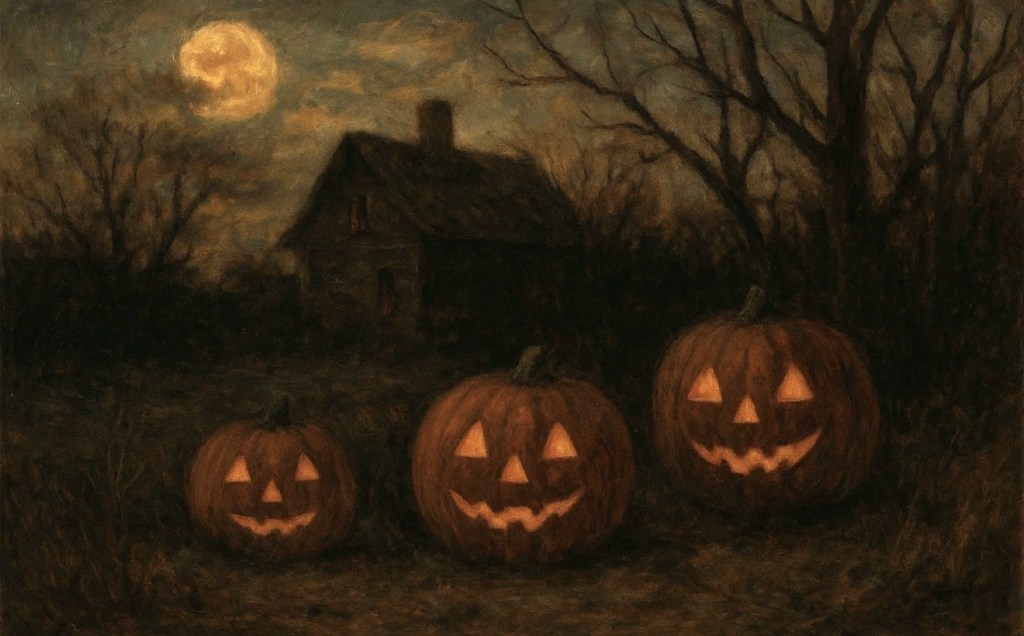
Before Halloween Had a Marketing Department: Ghosts, bad decisions, and the old mountain ways
By Lenora Bellhurst, The Appalachian G’Author
Before Halloween became an annual negotiation between your checking account and a twelve-foot skeleton, people managed to frighten themselves with considerably less equipment.
A dark window. A strange sound beyond the porch. A story that began, “Now, I don’t know whether you believe in such things,
Here in Appalachia, Halloween found a landscape well suited to the assignment. Mountains disappearing into fog. Early darkness. Enough woods to conceal a perfectly respectable number of terrible decisions. And people carrying stories that had crossed an ocean long before anybody thought to sell individually wrapped “fun.”
Let’s follow those stories backward for a moment. So grab your coffee, and sit a spell. Oh…. And apparently, we may also need a turnip.
One of Halloween’s oldest roots reaches into Samhain, the Gaelic seasonal festival associated with the beginning of winter. In Ireland, November 1 marked that threshold, with celebrations beginning the evening before. The agricultural year was turning toward darkness, and folklore gave the night some unusually complicated houseguests.
The National Museum of Ireland describes traditions in which the dead might return to the family home, troublesome spirits were abroad, and people avoided traveling alone. There were also feasts, games, and attempts to discover whom one might marry. Because even with ghosts wandering about, somebody still wanted to discuss your relationship status. Some things really are eternal.
Halloween developed through centuries of change, including Christian observances of the dead and saints. Its name comes from All Hallows’ Eve, the evening before All Saints’ Day. The holiday we inherited carries layers of seasonal celebration, religion, folklore, and community entertainment. Trying to give every modern custom a single ancient origin is how you end up confidently explaining something you learned from a decorative tea towel.
Scottish, Irish, and Scots-Irish traditions became important strands in American and Appalachian culture. The National Park Service notes that Scots-Irish families settling around Cumberland Gap brought their traditions, music, and language with them. Many such migrants were Christians; carrying a folk belief did not mean arriving with a suitcase full of Druid robes.
Nor did everyone in Appalachia inherit identical customs. Family, community, religion, and generation all mattered. We can appreciate the Gaelic connections without pretending every mountain grandmother belonged to the same secret coven.
Although I would absolutely read those meeting minutes.
Consider the lantern. Before the smiling supermarket pumpkin, Scottish Halloween traditions included hollowed-out turnips carved into alarming faces and illuminated from within. The National Trust for Scotland describes these lanterns as protection against malevolent spirits. In North America, pumpkins offered a considerably easier carving project, and so, the tradition was carried on here.
If you’ve seen an old turnip lantern, you understand the appeal. A pumpkin usually looks festive. A turnip looks like it has information about a disappearance and would prefer you stopped asking questions.
That particular vegetable came prepared to do its job.
Scottish guising also involved dressing up and visiting neighbors, sometimes performing a joke or song in exchange for treats. Folklore connected disguises with protection from wandering supernatural beings. Guising belongs among the predecessors of modern trick-or-treating, though today’s American candy circuit developed through later changes.
Imagine telling a modern child they must perform before receiving chocolate. Suddenly that skeleton costume requires an audition.
And then there was the fortune-telling.
Historic Environment Scotland records Halloween customs involving nuts placed in a fire to judge a couple’s prospects and kale stalks pulled to predict a future partner’s appearance or wealth. Robert Burns even included kale-pulling in his poem “Halloween.”
Before dating apps, apparently, there was prophetic salad.
I respect the efficiency. The kale cannot send you “wyd” at 11:47 p.m. and then explain why its ex was the problem.
Across the Atlantic, mountain accounts preserve their own Halloween courtship games. The Asheville Museum of History describes a belief that a young woman might glimpse her future husband while eating an apple and brushing her hair before a mirror. Another involved circling the house backward while looking into a mirror.
Love apparently required excellent balance and a worrying disregard for porch steps.
These were folk beliefs and entertainments, of course, with no guarantee your future husband would materialize. Honestly, if a man appears behind you in a dark mirror without introducing himself, I have concerns about his boundaries.
Early twentieth-century western North Carolina Halloween also offered parties, costumes, and apple bobbing. The Asheville museum draws on local newspapers and oral histories: George Rodgers remembered bobbing for apples as a boy, while Harley Ownbey recalled young men putting wagons on houses or in trees during the 1920s. Churches and the YWCA hosted decorated gatherings and dances,
And can we please take a moment to acknowledge the act of lifting a wagon to a roof?
Somebody had to organize that. Somebody needed help. Somebody looked at a perfectly functional wagon and thought, The roof. Obviously.
Our ancestors could accomplish a great deal when they applied themselves to being a nuisance. And, honestly, I find this to be a delightfully fitting attribute to Appalachian culture.
That older Halloween could be sociable, flirtatious, spooky, and occasionally a tremendous inconvenience to whoever owned the wagon. Its entertainment relied on people making something happen: telling a story, playing a game, assembling a disguise, or attempting amateur clairvoyance with produce.
Then the candy companies recognized an opportunity.
To be fair, they did not invent Halloween, sweets, or visiting neighbors for treats, but they certainly helped make packaged candy feel like the holiday’s central obligation. In fact, Smithsonian’s National Museum of American History notes that manufacturers increasingly targeted Halloween in the 1950s. Earlier trick-or-treat offerings could include homemade cookies, cake, popcorn balls, apples, coins, and small trinkets.
Eventually, a seasonal celebration with ghosts, games, and uncertain romantic futures became an occasion to purchase enough miniature chocolate to provision a small expedition.
Am I eating some of that chocolate tonight? Absolutely. My principles have a peanut-butter exception.
But I like remembering how much Halloween offers beyond the shopping list.
A story told slowly enough to make the room go quiet. Apples and laughter. A disguise made from whatever you can find. The delicious uncertainty of looking toward the tree line after somebody mentions a ghost.
Tonight, let the mountains provide a little of the atmosphere. Tell a tale. Remember somebody you miss. Enjoy your candy. Give the dark its moment.
And if you hear something outside, perhaps check the wagon before accusing the spirit world.
Happy Halloween.


Leave a Reply