Rotherwood Mansion, Part II: The Devil Came to Rotherwood
The documented history—and considerably darker folklore—of Joshua Phipps
If Rowena Ross is the sorrowful ghost of Rotherwood Mansion, Joshua Phipps is something else entirely.
Something darker.
And, unfortunately, unlike a spectral bride wandering the Holston in her wedding dress, we don’t have to rely entirely on ghost stories to establish the unsettling part of Phipps’s history.
Joshua Phipps was real. He owned Rotherwood. And, though slavery was not as widespread in the East Tennessee Mountains, he owned human beings.
And he had a reputation as a cruel owner, even by pre-Civil War standards.
So grab your coffee, light a candle if that’s your thing, and come back with me to the banks of the Holston.
Because Rotherwood’s story didn’t end with Rowena.
Arguably, that’s where it got considerably worse.
The Ross Era Ends
The Rotherwood we see today is actually what historians call Rotherwood II.
Frederick Augustus Ross began constructing Rotherwood I around 1818 while construction also began on what became Rotherwood II across the road. According to the City of Kingsport’s historic preservation records, Rotherwood II developed in stages: a two-story northern section, another parallel two-story section probably built around 1820, and eventually a central three-story portion connecting them in the mid-nineteenth century.
In other words, Rotherwood wasn’t simply plopped onto the hillside one Tuesday afternoon looking like a ready-made Southern Gothic movie set.
It grew over time.
In 1847, Frederick Ross sold most of his property, including Rotherwood II, to Joshua Phipps, who had served as his plantation overseer. ( Kingsport, TN ) And this is where we need to talk about something that ghost stories have a bad habit of turning into spooky window dressing:
Rotherwood was a plantation worked by enslaved people.
Those people were not props in someone else’s haunted-house story. They lived there. They worked there. They had families there. And their enslavement is part of Rotherwood’s documented history. In fact, if you have never dug into the history of enslaved persons there, it leads down a fascinating old winding road to Hawkins County, but that’s a rabbit hole for another time.
Joshua Phipps: Where History Gets Uncomfortable
Modern versions of the Rotherwood legend frequently describe Phipps as extraordinarily cruel. In fact, some stories attribute almost cartoonishly evil acts to him. We’ll get to those.
But before we wander into folklore, there is one extraordinary surviving document that allows Joshua Phipps to speak for himself: his will.
And it isn’t comfortable reading.
The document names enslaved people individually as property to be inherited. Among them are Andy, Lewis, Jack, Rufus, Viney, Maria, Sal, Rufus and Mary. It also assigns Rotherwood Mansion and surrounding property to Phipps’s wife, Ann, for the duration of her life. ( TNGenWeb )
Think about that for a moment.
Behind the grand columns, sweeping grounds and romantic stories about antebellum Rotherwood were real people whose futures could be distributed in a legal document along with land, furniture, crops and household possessions. That is not a ghost story.
That happened. But, to be fair, Phillips wasn’t the first one to purchase humans and make them work the Rotherwood property. He was Ross’ overseer before he owned the place. Phipps’ reputation is what sets him apart from Rotherwood’s initial owner.
Which makes the legends that grew around Phipps’ residence there considerably more interesting. Folklore, after all, has a funny way of remembering people.
Sometimes history records the deeds. But folklore delivers the verdict.
So…Was Joshua Phipps Really a Monster?
Here’s where your friendly neighborhood Appalachian G’Author has to ruin a perfectly good campfire story with responsible research.
Maybe. But we need to be careful about what we claim as fact.
Later accounts portray Phipps as exceptionally brutal toward the people he enslaved. Stories tell of beatings, punishments and terrifying treatment of people attempting to escape.
Those stories have become deeply embedded in local Rotherwood lore.
But many of the most gruesome details appear in later oral histories and paranormal retellings rather than contemporary documentation.
There is, however, documentary evidence that Phipps enslaved numerous people, and his will treats those people as transferable property. The Kingsport Public Library and Archives also preserves substantial material concerning Frederick Ross, Joshua Phipps, Rotherwood and slavery, including Ross’s infamous 1857 pro-slavery work, Slavery Ordained of God. ( Kingsport Public Library and Archives )
So no, the Ross period wasn’t some idyllic pre-Phipps paradise either.
That’s an important correction to the prettier versions of this story.
Rotherwood’s darkness didn’t begin when Joshua Phipps walked through the door.
Slavery was already there.
Then Phipps Died.
And this is where history politely excuses itself from the room and Appalachian folklore kicks the door open.
Joshua Phipps died in 1861.
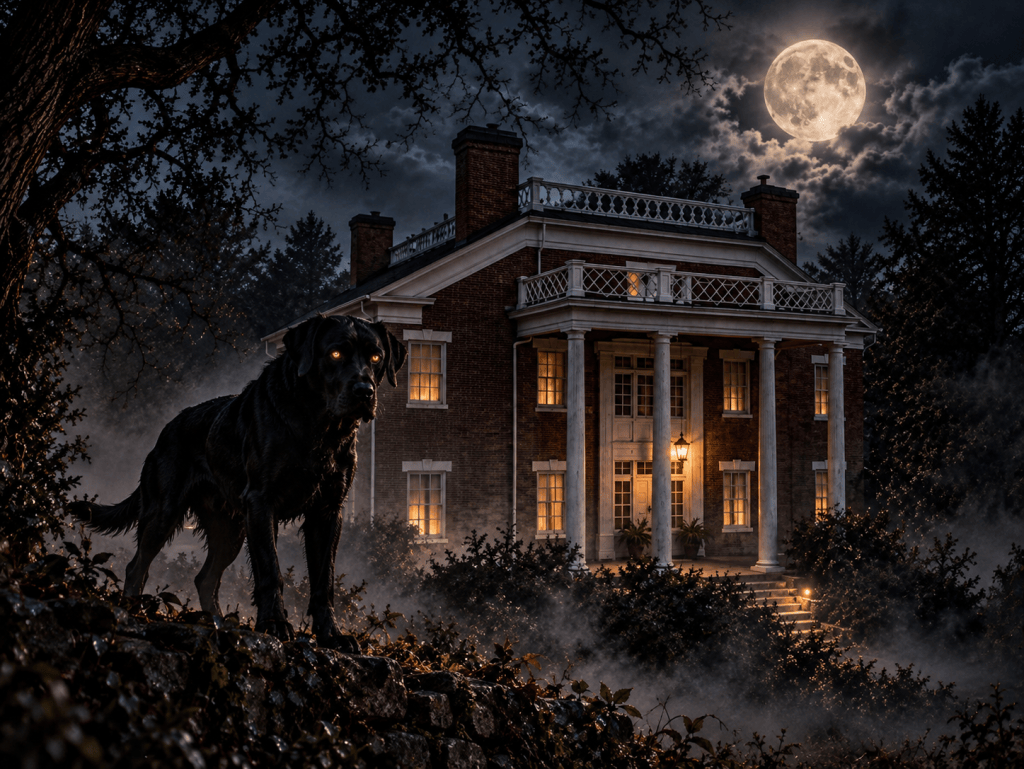
According to one of Rotherwood’s most enduring legends, he became gravely ill and spent his final days at the mansion, surrounded by the people he had enslaved and the wealth he had accumulated. The story says that as he lay dying, a mysterious black dog appeared at the house.
Not a neighbor’s dog.
Not a stray.
A huge, shadowy animal with burning eyes.
The kind of supernatural hellhound that makes every sensible person in East Tennessee reach for a shotgun and every storyteller reach for a second cup of coffee.
Some versions say the animal appeared at the foot of Phipps’s bed. Others place it outside the mansion, pacing beneath the windows. In the most dramatic retellings, the dog was understood to be the Devil himself, arriving to collect what Phipps owed.
But when Phipps died, the dog vanished. No tracks were found. No one could explain where it had come from. That is the folklore.
The documented record is less theatrical. Phipps died in 1861, and his will shows the structure of the world he left behind: land, a mansion, wealth and enslaved people legally assigned to his heirs.
But the black dog story survived because it gave the community a way to interpret his death.
Phipps had spent his life exercising power over other people. So folklore imagined that, at the end, something more powerful came for him.
The Devil’s Dogs/Hellhounds
The black dog is not unique to Rotherwood.
Across the British Isles, the American South and Appalachia, black dogs appear in stories as omens of death, guardians of forbidden places or supernatural messengers. Sometimes they are protectors. Sometimes they are warnings.
And sometimes they are exactly what you want to see standing outside the home of a man whose will lists human beings as property and who lore paints as a brutal, bloodthirsty, and cruel individual.
Rotherwood’s version may have grown from older traditions, local memory, and the moral weight of Phipps’s reputation.
That doesn’t make the story historically verified. But it does make it culturally revealing.
The legend isn’t really about whether a literal demon dog stood beside Phipps’s deathbed. It’s about the belief that cruelty leaves a stain on its debtors. And that eventually, somehow, the bill comes due.
The Civil War Comes to Rotherwood
Phipps died as the country was coming apart at the seams.
The Civil War reached East Tennessee in ways that were violent, confusing, and deeply personal. Rotherwood stood near the Holston River and along routes that mattered militarily, making the property vulnerable to occupation, movement, and disruption.
The mansion survived the war, but the world that had sustained it did not. Emancipation destroyed the legal system that had allowed men like Phipps to treat human beings as inheritable property. The people named in his will were no longer supposed to belong to anyone.
That transformation did not erase the violence that came before it. It did, however, change the meaning of the house.
Before the war, Rotherwood represented wealth, status and control. Afterward, it became a surviving monument to a system that had collapsed. And, as often happens with old houses, the stories grew more theatrical as the facts became harder to live with.
The Haunting of Rotherwood
Today, Rotherwood is associated with several different kinds of haunting.
There is Rowena Ross, the tragic bride who supposedly wanders the riverbank discussed in Part 1. There is Joshua Phipps, remembered in darker stories as a cruel master whose death attracted something infernal.
But there are also tales of footsteps, voices, cold spots, and unexplained movement inside the mansion. And then there is the haunting that doesn’t require a single ghost.
The people who were enslaved at Rotherwood left behind fewer written records than the men who owned them. Their names appear in wills and inventories, but their voices are much harder to recover.
That absence is part of the haunting. A house can be haunted by a woman in a wedding dress. It can be haunted by a black dog.
But it can also be haunted by atrocities never recorded by history.
What We Can Say
Here’s the honest version: Joshua Phipps owned Rotherwood. He enslaved people. His will documents that fact. He died in 1861.
The black dog, the Devil’s visit, and the more elaborate stories of supernatural punishment belong to folklore rather than confirmed history.
But folklore doesn’t appear from nowhere.
It grows around memory, guilt, fear and the need to make sense of the past. The people of this region remembered Phipps as a man associated with power and cruelty. Over time, that memory took the shape of a supernatural story.
A demon came for him. A black dog waited outside.The Devil came to Rotherwood.
Maybe.
Or maybe the real devil had already been there for decades, wearing a respectable coat, signing legal documents, and calling other human beings his property.
And that, friends, is the part of the story that doesn’t need a ghost.
It’s frightening enough on its own.


Leave a Reply