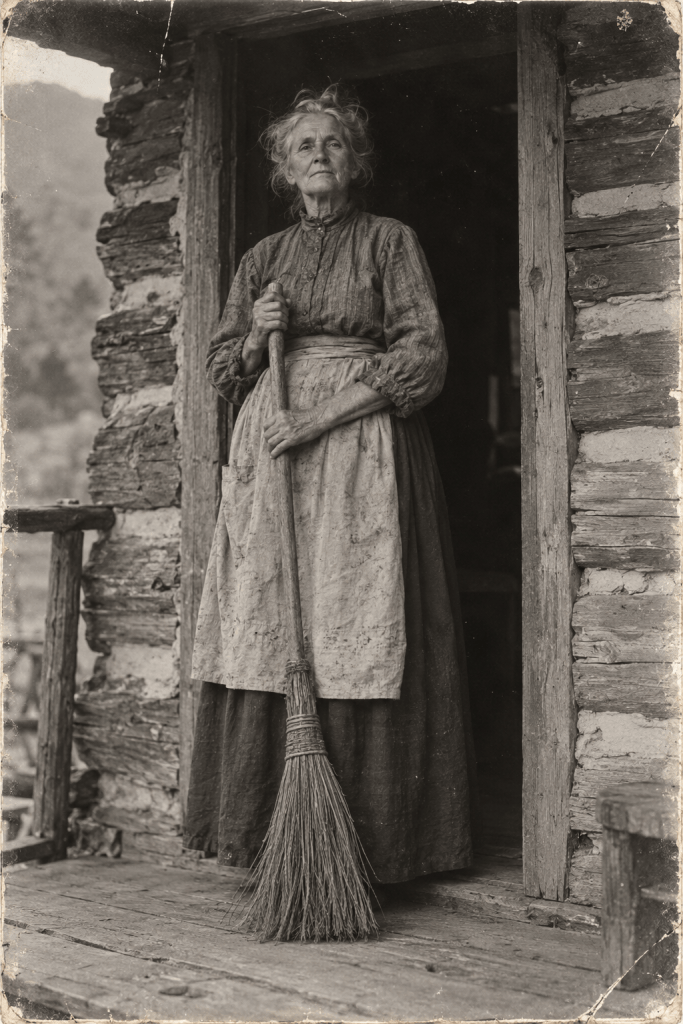
Sweep the Floor, Mind the Spirits: The Broom’s Double Life in Appalachia
Things Granny Told You Not to Do, Part Two
By Lenora Bellhurst | The Appalachian G’Author
A broom leaning beside an old mountain doorway looks innocent enough. That is, until you learn it might be there to catch a witch.
Or protect the house.
Or interfere with somebody’s marriage prospects.
Apparently, getting the floor clean was the entry-level position for housekeeping in Appalachia.
In Appalachian folklore, the broom stands at a delicious crossroads between practical housekeeping and supernatural housekeeping. It moves dirt, marks boundaries, and collects warnings about what happens when you sweep the wrong thing, at the wrong time, in the wrong direction.
And today, people are learning to make these beautiful, useful, faintly suspicious objects all over again.
Folklore note: These beliefs vary by family and community, and many have counterparts outside Appalachia. Historical witch accusations, household superstitions, modern spiritual practices, and broom-making traditions overlap, but they are not interchangeable.
First, it really was about the dirt.
Before considering the spirits, we should acknowledge the crumbs. A handmade broom is a piece of practical technology. The maker selects and arranges fibers, binds them securely, and shapes the finished tool for a particular job. Hearths, floors, corners, and tabletops do not all need the same broom.
Smithsonian’s reporting on Berea College describes broomcorn being wound onto a handle under tension, followed by braiding and, for flat kitchen brooms, stitching. It also distinguishes shorter hearth brooms, corner-cleaning “cobwebbers,” and hand-sized turkey-wing whisks.
Broomcorn, despite the name, is a kind of sorghum—not the ears of corn destined for supper. The Museum of Appalachia identifies it as the material used in the hand-tied brooms of Knoxville maker Amelia Galvas.
There is something deeply satisfying about that relationship between plant and household tool: something grown outdoors becomes the means of putting the indoors back in order.
Also, it does not require charging.
Don’t sweep my feet unless you’re paying for the wedding.
Appalachian cultural writer Tipper Pressley records several broom warnings on Blind Pig and the Acorn. Among them: sweeping beneath someone’s feet could keep that person from marrying; sweeping after dark was forbidden; and sweeping trash out the door brought bad luck. She specifically remembers hearing the marriage warning as a teenager.
Imagine attempting to clean the kitchen and accidentally canceling someone’s entire romantic future.
The lore gives a simple chore consequences far beyond the dustpan. Feet, doors, darkness: ordinary details become places where you have to pay attention.
The warnings can also collide with practical necessity. In the comments beneath Pressley’s post, one reader remembers a mother who swept dirt straight outside because six children kept tracking it in.
There are traditions, and then there is a woman who has already cleaned that floor twice today.
I would not argue with her.
A broom at the door: protection or a trap?
Here is where the lore gets wonderfully unsettling.
In “Mountain Mystics: Magic Practitioners in Appalachian Witchlore,” J. T. Chadwell and T. D. Martin describe a belief that placing a broom over or across the front door could expose a witch. In the variants they discuss, the witch would have to pick up the broom or count its bristles.
Picture the threshold at night: a dark doorway, a rough wooden handle, and a visitor who cannot quite bring themselves to come inside.
That is a better opening to a horror story than most things requiring a special-effects budget.
The broom’s association with witchcraft could, therefore, work in two directions. It belonged to the witch in familiar imagery, yet it could also become a household defense against one.
Comparable stories appear elsewhere. The University of Reading’s Museum of English Rural Life records British beliefs in which a broom across a doorway could signify witchcraft, and picking it up could identify the witch. These are British parallels, rather than evidence that every Appalachian version followed the same rules.
In this case, the domestic object becomes a test. Unfortunately, the test appears to punish anyone inclined to tidy up.
Why the spirits apparently needed to count
One especially eerie variation appears in the University of Detroit Mercy’s James T. Callow Folklore Archive.
One record describes leaving a broom or a bucket of sand outside on Halloween. A harmful spirit would have to count the bristles or grains before entering. Counting would occupy it until daylight, when it had to leave. The archive identifies this particular account as an Italian family tradition collected in Illinois.
It should not be relabeled as an Appalachian custom. But alongside the mountain broom-counting motif, it offers a fascinating comparison.
The threatened household does not overpower the intruder. It gives the intruder an impossible chore.
I find this approach to supernatural security extremely relatable.
Should anything malevolent arrive at my house, I have plenty fitted sheets the pesky little goblin could fold.
Where housekeeping meets witchcraft
The symbolic connection is easy to see: sweeping physically removes what you do not want in a room. Ritual sweeping gives that familiar action an additional meaning. In a 2017 report about Cleveland’s Buckland Museum of Witchcraft and Magick, curator Jillian Slane described the broom’s use for ritual cleansing of a space. This documents a modern religious use; it does not establish that earlier Appalachian housekeepers secretly practiced Wicca.
This is an important discrepancy. A person can observe a family superstition, pray over a home, practice contemporary witchcraft, or make beautiful brooms without sharing the same beliefs.
My interpretation is that the broom’s appeal lies partly in how naturally it connects action with intention. You clear the floor while thinking about what else you would like to clear from your life: an argument, an exhausting week, the emotional residue of someone who stayed entirely too long.
The practical work happens either way.
Sometimes a clean kitchen feels like a blessing because you have finally located the kitchen.
Old Broomcraft is finding new hands
The renewed interest in broomcraft is more than a seasonal fondness for witchy decorations.
In 2021, Architectural Digest reported increased enthusiasm for artisan brooms, including strong demand for Cynthia Main’s Sunhouse Craft classes, kits, and finished brooms in Berea, Kentucky. That reporting documents a recent revival of interest, rather than measuring the entire craft market today.
Nor did broom-making disappear and wait for social media to resurrect it.
Berea College’s workshop opened in 1920. Its continuing tradition joins skilled labor with artistic design, and Smithsonian’s 2020 profile reported renewed interest in the craft. The same article cautions against imagining one definitive “Appalachian broom” style across such a large and culturally varied region.
Berea’s own magazine describes Christopher Robbins teaching students to take pride in making a tangible object—and encouraging them to keep their first broom, however imperfect.
That is how a tradition gets another generation: somebody teaches, somebody struggles, and eventually somebody makes a thing worth keeping.
The revival is happening here in East Tennessee, too
The Museum of Appalachia has advertised hands-on workshops with Aviary Broom Co., founded by Knoxville broomsquire Amelia Galvas. Its description presents her work as both a revival and a reinvention: hand-tied broomcorn, traditional techniques, colorful dyed grasses, and experiments with other fibers and ties. Workshop participants make useful objects, including a hand whisk and a cake tester.
The craft can hold both continuity and change. A broom need not look old to carry knowledge forward.
And a purple broom does not become less useful because somebody enjoyed making it beautiful.
For some people, the attraction is heritage. For others, it is the pleasure of making a household object, supporting an artisan, or using something that feels good in the hand.
For a modern witch, there may be ritual meaning, too.
The maker’s own explanation is a better guide than assuming every dramatic-looking broom has been moonlighting in a coven.
A little respect for the broom
What draws me to broom lore is how much meaning gathers around an ordinary act. Keeping house means deciding what stays, what goes, and what gets through the door. In these stories, the broom makes those decisions visible.
It can be useful, beautiful, protective in someone’s belief, or simply the thing standing between you and an advancing civilization of dust bunnies.
So admire the braid. Ask who made it. Learn the story that came with it.
And if you are visiting someone whose broom is laid across the threshold, perhaps pause before moving it.
The housekeeping rules are complicated.


Leave a Reply