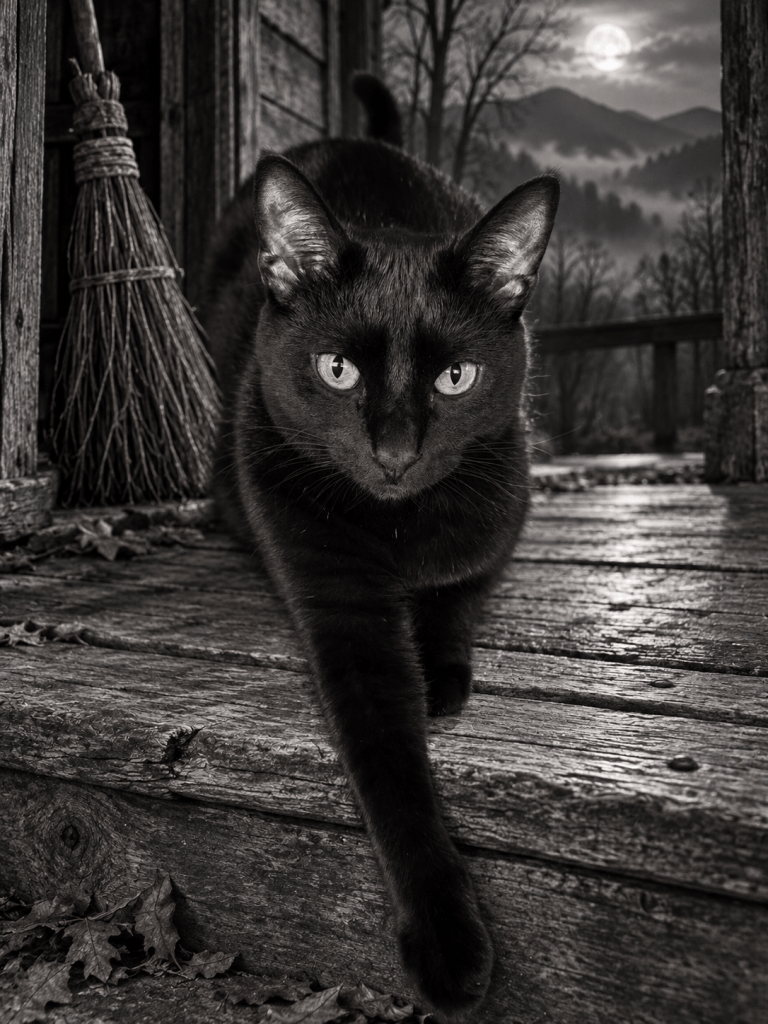
Black Cats, Bad Luck, and Other Things We Blamed on the Cat
Things Granny Told You Not to Do, Part One
By Lenora Bellhurst | The Appalachian G’Author
A black cat slips across a mountain road at dusk. Somewhere, someone reaches for an imaginary emergency brake and begins drawing Xs in the air.
The cat, meanwhile, has places to be. Probably underneath a porch. Possibly inside somebody’s unattended grocery bag or Amazon box, if your black cat is anything like mine.
For an animal that spends a considerable portion of its life asleep, the black cat has accumulated an impressive workload: predicting misfortune, assisting witches, attracting prosperity, and taking responsibility for whatever went wrong after it crossed the road.
As a crazy cat lady and notorious misanthrope, I feel compelled to ask whether we have considered blaming actual people. They seem considerably more qualified at making mayhem.
But behind the jokes is a fascinating piece of folklore—one that belongs to Appalachia without belonging only to Appalachia. Even within the region, a family story is a family story, not a rulebook issued to every household with a view of a ridge.
The cat crossed the road. Now what?
One particularly vivid Appalachian custom comes from southwestern Virginia.
In a 2014 article for Smoky Mountain Living, journalist Jake Flannick interviewed Kimberly Burnette-Dean, who grew up in Meadows of Dan. She described tracing three Xs in front of the windshield when a black cat crossed the road. The protective gesture had a deadline: finish before the cat reached the other side. Apparently, supernatural disaster prevention comes with timed assessments. As an educator, I vehemently reject this notion.
Burnette-Dean also recalled a childhood neighbor who would return home and stay there after encountering a black cat. These accounts illustrate how differently people could respond to the same omen: one person made a quick gesture; another canceled the day.
The cat received no opportunity to explain itself. Not that it would give anyone the satisfaction anyhow.
How did a house pet get mixed up with witches?
The association extends beyond Appalachian tradition. Carnegie Museum of Natural History notes that some European folklore connects black cats with witches and treats their crossing a person’s path as a warning of misfortune.
That gives us a wider context for the familiar image of a witch with a black cat. It does not, however, establish a tidy, uninterrupted route from one European belief to every Appalachian family’s version.
Folklore rarely arrives with a shipping label.
Nor does a historical belief prove that the people accused of witchcraft were practicing it. The stories tell us about human fears and accusations; they do not provide evidence against the cat—or the woman feeding it.
Still, you can appreciate the casting decision. A dark silhouette. Bright eyes. An ability to stare at an empty corner until everyone in the room becomes uncomfortable.
The cat knows how to leave an impression. I respect that.
Plot twist: sometimes the cat brought the luck
The black cat’s reputation was never uniformly terrible.
The Carnegie museum points to Welsh folklore in which black cats brought good luck to a household and could signal changes in the weather. That is Welsh comparative folklore, rather than evidence that every mountain family held the same belief. But it demonstrates how differently people could interpret the same animal.
There are also positive accounts of these delightful little fur balls in Appalachia, which brings joy to my dark little heart.
In a 2018 essay on the blog Holy Stones and Iron Bones, the writer describes a family tradition in which a black cat arriving at the home and staying was associated with prosperity. The essay also records directional variations: a stray cat crossing one way could carry luck away, while crossing the other could bring it in.
This is a personal account of family lore, not a survey of Appalachia. Its value lies in preserving a particular version.
And what a version. The cat is apparently managing incoming and outgoing fortune.
My furry little freeloader can feel free to stay out of my finances. I have seen the poor life choices he makes around cardboard.
So why keep telling these stories?
My reading is that the most interesting part is the small human ritual surrounding the animal: that quick gesture, that remembered warning, that moment of hearing an older relative’s voice in your head.
You can doubt an omen and still remember exactly what you were supposed to do about it.
That does not make mountain people uniquely superstitious. In fact, anyone who owns “lucky” game-day clothing should approach this discussion with humility. But I digress.
Recording these beliefs also gives us a reason to ask better questions. Who told the story? Where did they live? Was it a serious warning, a joke, or something they repeated while insisting they did not believe a word of it? Those details preserve more than a spooky list. They preserve people.
As for the actual black cat, I am inclined to offer a comfortable place to sit and let it get on with its mysterious business.
If one crosses your path, perhaps your luck is changing.
Perhaps a mouse’s luck is changing.
Either way, the cat would appreciate being left out of your next complaint about the universe.


Leave a Reply