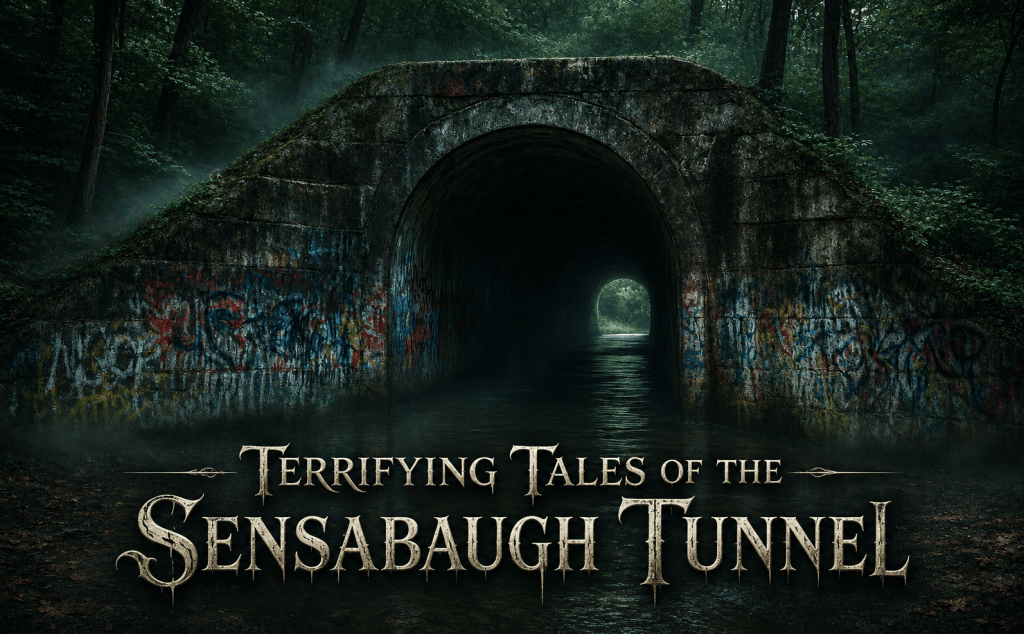
The Sensabaugh Tunnel in Kingsport is the eerie setting for a variety of local unexplained events.
By Lenora Bellhurst | The Appalachian G’Author
In Appalachia, we understand that a shortcut can come with consequences.
You might save five minutes. You might hear something crying in the darkness. You might even acquire a passenger who wasn’t there when you left the house.
Naturally, somebody’s cousin’s sister’s boyfriend will insist the best time to take a shortcut is precisely after midnight.
Enter Sensabaugh Tunnel, the Kingsport-area landmark whose reputation suggests that ordinary infrastructure simply wasn’t dramatic enough. The City of Kingsport dates its construction to the 1920s and says it was named for landowner Edward Sensabaugh. What happened afterward depends very much on who is telling the story.
Today, the tunnel looms near the end of a winding river road shaded most of the year by a canopy of thick trees that darken the already gloomy atmosphere. It’s general mood, combined with a variety of lore and urban legend attached to it, the Sensabaugh Tunnel is a local spot associated with a plethora of haunting experiences, from literal bumps in the night to mysterious cries and car engine malfunction.
It’s a place most people avoid…unless they’ve been dared.
As far as local lore goes, the Sensabaugh Tunnel has something for everyone. There’s a stolen baby. A murderous father. A stranded mother. And, possibly, one thoroughly aggravated man who wanted teenagers to hush.
Let’s wander through the versions—with a little light between the folklore and the facts.
The stolen baby legend
One of the best-known versions begins with hospitality betrayed.
According to the legend recorded by the City of Kingsport, Edward Sensabaugh welcomed a homeless man into his home. The visitor attempted to steal jewelry, and Edward confronted him with a gun. The thief then seized Edward’s infant daughter as a shield, escaped, and drowned her in the tunnel.
A different telling, published in ETSU’s East Tennessean, changes the final act: the fleeing thief throws the baby into water beside the tunnel to distract the pursuing father. The central horror remains, but the motive shifts from outright killing to a terrible diversion.
It’s a particularly cruel ghost story because it begins with someone opening a door to help another person.
After that, every sound in the darkness has an explanation waiting for it.
Another Variation: The father becomes the monster
Another version removes the stranger entirely.
In the City of Kingsport’s account of this legend, Edward himself kills his family and disposes of their bodies in the tunnel. The East Tennessean records an additional twist: after murdering his family, Edward allegedly flees toward the tunnel and dies by suicide. These are conflicting folklore accounts, not established biographies of Edward Sensabaugh.
But none of this is established fact.
A real surname can become attached to an imagined atrocity so firmly that repetition begins to pass for documentation. Tell the story often enough, and a man stops being somebody’s relative and becomes the villain waiting at the end of the road, which is most likely the case for Edward Sensabaugh.
And I always appreciate a good gothic villain. I also believe the living—and the dead—deserve better than having an accusation mistaken for a death certificate.
The mother who sheltered from a storm
A less familiar version appears in the Knox Paranormal Researchers’ collection of tunnel legends.
In this telling, a woman traveling with her child stops inside the tunnel to escape a worsening storm. By morning, both are found dead in their car. The account supplies no clear cause of death and explicitly acknowledges uncertainty about whether the event happened at all.
This version has a different kind of dread.
There is no intruder to outrun and no murderous patriarch to escape. There is simply a mother making what seems like the safest available choice.
Shelter becomes a trap, which is fertile ground for a good haunting, whether the ghosts actually arrive or the storyteller supplies them.
The unexpected passenger
The tunnel’s legends also include a woman who appears in the back seat of a passing car, a crying infant, and an engine that refuses to restart after a driver switches it off inside. Knox Paranormal Researchers records all three as reported claims.
The East Tennessean adds another flourish: small handprints supposedly left on vehicle windows after an encounter.
Notice how neatly these details turn a car into a little haunted house.
The locked doors no longer guarantee privacy. The engine no longer guarantees escape. The rearview mirror becomes something you would rather avoid.
Frankly, an uninvited passenger should at least contribute gas money.
Or perhaps Ed wanted everyone to go home
Then there is the explanation that feels wonderfully suited to a place where people value their peace.
The City of Kingsport includes a version in which Edward lived into old age and frightened troublesome teenagers by making eerie shrieks near the tunnel.
A 2015 essay in The Haunted Spots Blog gives that account more detail. Citing a 1995 Kingsport Times report and descendant Jack Sensabaugh, the writer describes Ed as a talented mimic who could imitate animals, a crying baby, and a screaming woman. Supposedly, he used those talents to send noisy young visitors scrambling. I have not independently examined the original newspaper article, so that attribution remains secondhand.
If that explanation is right, though, imagine the indignity.
You try to get some sleep. You chase away a few rowdy teenagers. Generations later, the internet has made you a murderer.
A stern request to keep the noise down apparently needed a much larger marketing department, which is an irony I find delightful.
What the darkness actually proves
Even investigators drawn to the legend have reported results that complicate it.
Knox Paranormal Researchers says its members repeatedly switched off their vehicle inside the tunnel, facing both directions, and successfully restarted it every time. They also reported a recording they interpreted as resembling a baby’s cry. That interpretation does not establish a supernatural source—or verify any of the alleged deaths.
The sources gathered here document the stories’ circulation. They do not establish the stolen infant, family murders, or storm deaths as historical events.
And perhaps that is the most interesting thing about Sensabaugh Tunnel: how many explanations can gather around one patch of darkness.
One teller hears grief. Another imagines violence. Another sees an irritated landowner putting on the performance of his life.
My own suspicion? A dark tunnel riddled with graffiti beside a foggy river engulfed on all sides by thick trees provides all the setting details for a spine-tingling yarn.
A good storyteller merely supplies the details.
But if somebody dares you to stop in the middle, kill the engine, and wait for the crying to begin, remember: you can enjoy Appalachian folklore without volunteering to become its next anecdote.
Keep the road clear, respect nearby property, and let the stories do the lingering.
Sources and further reading
- City of Kingsport — “Sensabaugh Tunnel”, November 8, 2016. Municipal retelling of three principal legends; it is not an archival crime report.
- Knox Paranormal Researchers — “Legends of Sensabaugh Tunnel”, April 1, 2015. Includes the storm-shelter version and the group’s account of its investigation.
- Ioanna Katsigianis, East Tennessean — “Tales of the Sensabaugh Tunnel”, September 11, 2025. Records variations involving the fleeing thief, the father’s alleged suicide, handprints, and the family’s alternative explanation.
- The Haunted Spots Blog — “Sensabaugh Tunnel: Haunted history or local folktale?”, October 30, 2015. Discusses the mimic explanation and attributes it to earlier newspaper reporting.


Leave a Reply